What AI day trading usually means, and what it means here
"AI day trading" conjures a bot firing nonstop. That is not the model Cortiq runs.
Is event-driven: it acts only when a trigger you defined fires.
Is one instrument, all day, in depth.
Is as few trades as the playbook justifies.
Is candle-timescale decisions a human can audit.
Three trigger types bound how often it can act
Wakes when the timeframe candle it watches closes, not before and not on every tick.
Wakes when price reaches a level you or the playbook defined, then goes back to sleep.
Wakes at a time you set: a session open, a news window, a fixed check-in.
Between triggers, the agent sleeps. It is not polling the market, and that gap between wakes is what keeps this day trading instead of constant firing.
See a full cycle, step by step →See the workspace, start to finish
A narrated tour of the one-market loop — research the edge, write the playbook, backtest it on real history, then go live — with every AI call and every guardrail on screen.
What caps how often it can trade
Mutating actions wait for you unless a session is explicitly set to run unattended.
Confine the agent to specific trading windows; outside them it won't act.
Enforced by a validator layer outside the model: per-symbol caps, drawdown limits, and a loss-streak stop built to catch overtrading on a bad day.
None of these three levers live inside the model's prompt. The model cannot argue its way past them.
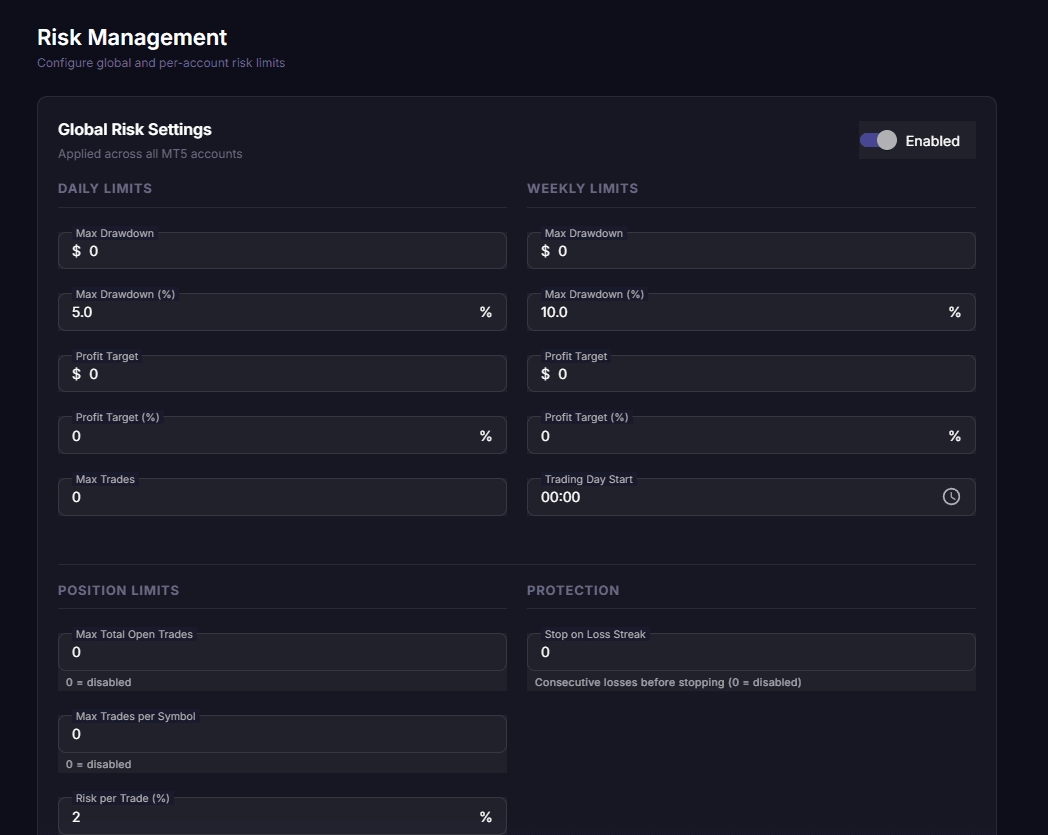
Be conservative about how often it trades
Trading financial markets carries a high degree of risk and may not be suitable for all investors. You can lose some or all of your invested capital. Read the risk disclosure.
Trading financial markets carries a high degree of risk and may not be suitable for all investors. You can lose some or all of your invested capital. Read the risk disclosure.
The full walkthrough behind this page: the complete trade cycle, the validator layer, and what Cortiq deliberately does not do.
See the full mechanicsOne-time activation key, bring your own AI, personal founder onboarding, and all future Cortiq desktop updates included.
Buy an activation keyOne-time · 14-day refund · 2-machine activation